




Texas Instruments ADC12DLx500 12-Bit Analog-to-Digital Converters
Texas Instruments ADC12DLx500 12-Bit Analog-to-Digital Converters (ADCs) are a family of ADCs that can sample up to 500MSPS, 1.5GSPS, and 2.5GSPS in dual-channel mode and up to 1GSPS, 3GSPS, and 5GSPS in single-channel mode. Programmable tradeoffs in channel count (dual-channel mode) and sample rate (single-channel mode) allow the development of flexible hardware that meets the needs of high-channel-count and wide instantaneous signal bandwidth applications.
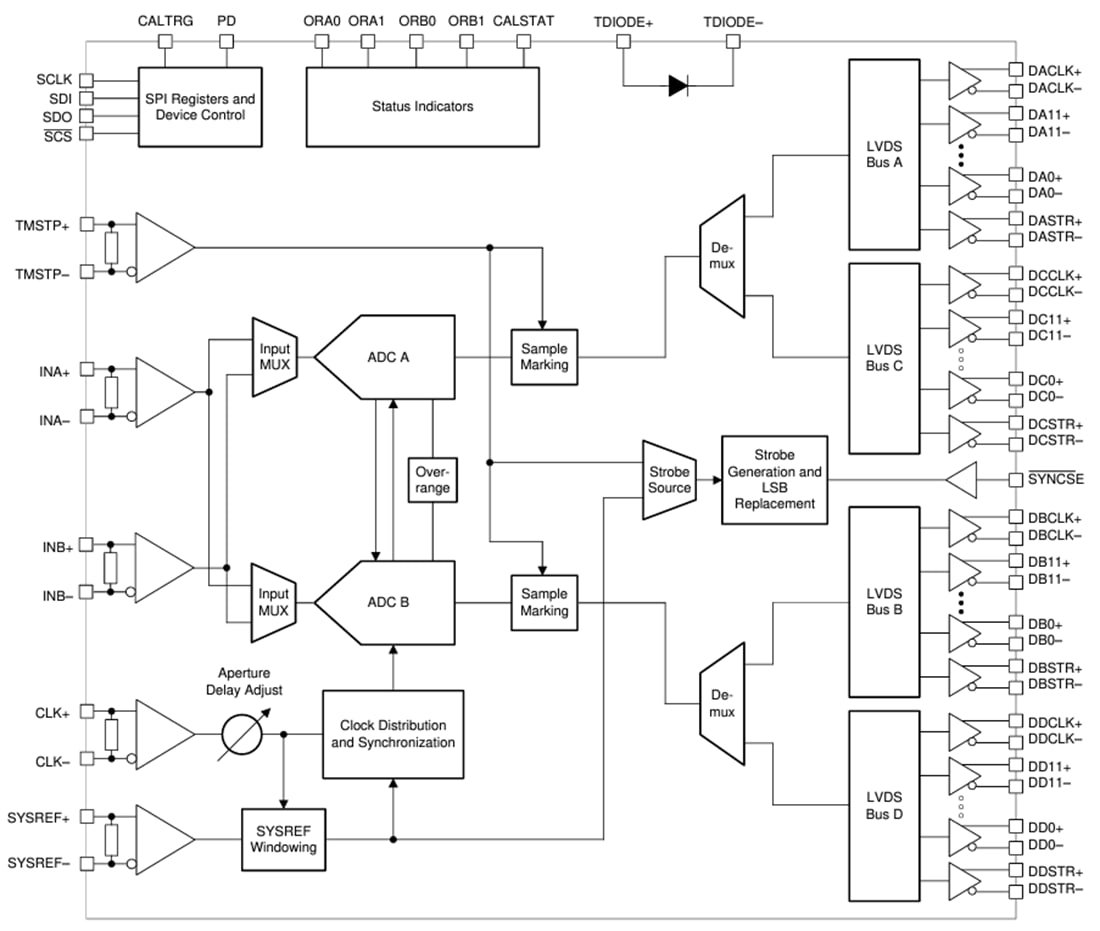
The Texas Instruments ADC12DLx500 uses a low-latency, low-voltage differential signaling (LVDS) interface for latency-sensitive applications or when the simplicity of LVDS is preferred. The interface uses up to 48 data pairs, four double data rate (DDR) clocks, and four strobe signals arranged in four 12-bit data buses. The interface supports signaling rates of up to 1.6Gbps. Strobe signals simplify synchronization across buses and between multiple devices. The strobe is generated internally and can be reset at a deterministic time by the SYSREF input. Multi-device synchronization is further eased by innovative synchronization features such as noiseless aperture delay (TAD) adjustment and SYSREF windowing.
Features
- ADC core
- 12-bit resolution
- Up to 1GSPS, 3GSPS, 5GSPS in single-channel mode
- Up to 500MSPS, 1.5GSPS, 2.5GSPS in dual-channel mode
- Internal dither for low-magnitude, high-order harmonics
- Low-latency LVDS interface
- <10ns total latency
- Up to 48 data pairs at 1.6Gbps
- Four DDR data clocks
- Strobe signals simplify synchronization
- Noise floor (no input, VFS = 1VPP-DIFF)
- Dual-channel mode: -143.5, -148, -149.8dBFS/Hz
- Single-channel mode: -146.2, -150.3, -152.2dBFS/Hz
- Buffered analog inputs with VCMI of 0V
- 8GHz analog input bandwidth (-3dB)
- 0.8VPP full-scale input voltage (VFS, default)
- Noiseless aperture delay (TAD) adjustment
- 19fs step precise sampling control
- Simplifies synchronization and interleaving
- Temperature and voltage invariant delays
- Easy-to-use synchronization features:
- Automatic SYSREF timing calibration
- Timestamp for sample marking
- Power consumption of 2.6W, 2.8W, or 3W
Applications
- Oscilloscopes and digitizers
- Electronic Warfare (SIGINT, ELINT)
- Time-of-flight and LIDAR distance measurement
- Microwave backhaul
- Automotive radar testers
- Spectrometry
Additional Resource
Functional Block Diagram
Related Development Tool

Texas Instruments ADC12DLxx00EVM Evaluation Module (EVM)
Helps evaluate the ADC12DLxx00, a 12-bit, dual 3.2GSPS or single 6.4GSPS, RF-sampling ADC.