Wireless headphones contain small speakers, receive signals via a short-distance
transmission link, and typically operate on a battery to
enable users to work without the hassle of a cord inhibiting movement and productivity.
Wireless technology replaces physical cabling where it is inconvenient, dangerous,
or impossible to use cables or wires...
Wireless headphones have the option to use several different wireless transmission
technologies such as FM, Bluetooth, and Wi-Fi.
Wireless headphones are also a useful, though not essential, option for remote monitoring, CD/DVD
players, home theater, personal computers, portable devices such as digital/mp3 players and mobile
phones; and disc jockeying, sound engineering and military functions, to name a few.
Two major methods of transmission for wireless headphones are IF
(Infrared) and RF (Radio Frequency).
Both types of wireless technology implement a transmitter and receiver system. The transmitter
connects to the audio source while the receiver is built-in to the wireless headphones, accepting incoming
signals and handing off the signal for processing in the signal chain until it reaches the speakers to create sound for
only your ears to hear.
Wireless headphones can also be separated into three categories depending on how they interact with the ear.
Circumaural headphones or full size headphones have circular earpads that completely surround the ear and can be
designed to form a full seal against the head to decrease unwanted external noise. Supra-aural headphones have pads
that sit on the ears instead of around them, and tend to be smaller and lighter than circumaural headphones, thus
providing less reduction of outside noise. And the last type is earbuds or earphones, which are much smaller, are
placed directly outside the ear canal without fully covering it, and are often favored for their general low cost,
small size, portability, and convenience.
Wireless Headphones Block Diagram
View Product List
This design is for reference only. The design, as well as the products suggested, has not been tested for
compatibility or interoperability.
Power Amplifier for Wireless Headphones
 An
RF
(
radio frequency
)
amplifier
, or
power amplifier
, is typically used to greatly increase the signal strength, or amplitude, of a current or voltage signal. In RF
applications, power amplifiers in a signal chain can be used to increase the power output of a signal such that
the signal can be projected over longer distances and around obstacles.
An
RF
(
radio frequency
)
amplifier
, or
power amplifier
, is typically used to greatly increase the signal strength, or amplitude, of a current or voltage signal. In RF
applications, power amplifiers in a signal chain can be used to increase the power output of a signal such that
the signal can be projected over longer distances and around obstacles.
Wireless Transceiver for Wireless Headphones
 Wireless technology enables the transfer of information over short or very long distances without cables. The
term "wireless" most often refers to telecommunications. Wireless communication is possible using a
wireless transmitter
and corresponding
receiver
. A
wireless receiver
refers to the receiving end of the information transfer and requires less energy to operate than the active
transmitting portion where the transfer originates.
Wireless technology enables the transfer of information over short or very long distances without cables. The
term "wireless" most often refers to telecommunications. Wireless communication is possible using a
wireless transmitter
and corresponding
receiver
. A
wireless receiver
refers to the receiving end of the information transfer and requires less energy to operate than the active
transmitting portion where the transfer originates.
Low Noise Amplifier for Wireless Headphones
 A
low noise amplifier
, or RF (Radio Frequency) amplifier, increases the amplitude of weak signals so that the RF receiver can work on
the signal, while introducing as little noise as possible. An
LNA
is a critical component in RF front-end circuitry. It has been found that the first stage or stages in the
signal chain after the receiver's antenna contribute the most to the total noise of an RF front-end circuit. Any
noise then introduced by the remainder of the signal chain is then made smaller in comparison to the amplified
signal, thus preserving signal integrity.
A
low noise amplifier
, or RF (Radio Frequency) amplifier, increases the amplitude of weak signals so that the RF receiver can work on
the signal, while introducing as little noise as possible. An
LNA
is a critical component in RF front-end circuitry. It has been found that the first stage or stages in the
signal chain after the receiver's antenna contribute the most to the total noise of an RF front-end circuit. Any
noise then introduced by the remainder of the signal chain is then made smaller in comparison to the amplified
signal, thus preserving signal integrity.
Processor for Wireless Headphones
 The term "
processor"
refers to an electronic device that performs computational functions and carries out the instructions of a stored
program. Other terms for
processor
are microprocessor, central processing unit, and digital signal processor. Essentially, the
processor
refers to "the brains of a computer."
The term "
processor"
refers to an electronic device that performs computational functions and carries out the instructions of a stored
program. Other terms for
processor
are microprocessor, central processing unit, and digital signal processor. Essentially, the
processor
refers to "the brains of a computer."
Audio DAC for Wireless Headphones
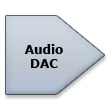 A
digital-to-analog converter (DAC)
is a semiconductor device that is used to convert a digital code (usually binary) into an analog signal, such as
electric charge, current, or voltage. A
DAC
is the principal means by which computer and digitally-based systems translate digital data into real-world
signals. An audio-quality
DAC
has specifications tuned for audio applications such as a high dynamic range with low to no distortion.
A
digital-to-analog converter (DAC)
is a semiconductor device that is used to convert a digital code (usually binary) into an analog signal, such as
electric charge, current, or voltage. A
DAC
is the principal means by which computer and digitally-based systems translate digital data into real-world
signals. An audio-quality
DAC
has specifications tuned for audio applications such as a high dynamic range with low to no distortion.
Headphone Amplifier for Wireless Headphones
 Headphone amplifiers
have specifications tuned for driving headphone speakers.
Amplifiers
have enormous voltage gain, use feedback to operate, and can be classified in different ways. They can be
identified by the device they are intended to drive (e.g., headphone amplifier, speaker amplifier), the input that
they are to amplify (e.g. guitar amplifier), the frequency range of the signal (e.g., RF, Audio), and by the
function that they perform (e.g. inverting amplifier, power amplifier.)
Headphone amplifiers
have specifications tuned for driving headphone speakers.
Amplifiers
have enormous voltage gain, use feedback to operate, and can be classified in different ways. They can be
identified by the device they are intended to drive (e.g., headphone amplifier, speaker amplifier), the input that
they are to amplify (e.g. guitar amplifier), the frequency range of the signal (e.g., RF, Audio), and by the
function that they perform (e.g. inverting amplifier, power amplifier.)
Batteries for Wireless Headphones
 In any electrical application, a
battery
converts stored chemical energy into electrical energy in order to power an electrical system. In a
wireless headset
,
batteries
are necessary in order to run the headset without a power cord or similar connection.
In any electrical application, a
battery
converts stored chemical energy into electrical energy in order to power an electrical system. In a
wireless headset
,
batteries
are necessary in order to run the headset without a power cord or similar connection.
ESD Protection for Wireless Headphones
 Electrostatic Discharge (ESD)
is an instantaneous electric current that flows from a higher to a lower voltage potential without warning. One of
the more well-known causes of
ESD
is static electricity, which is created when insulator surfaces rub together. Permanent damage can occur to
semiconductor devices that are exposed to
ESD
. An
ESD
current waveform has an extremely fast rise time.
ESD protection chips
can be very effective but consume board space and add capacitance to an I/O line.
Electrostatic Discharge (ESD)
is an instantaneous electric current that flows from a higher to a lower voltage potential without warning. One of
the more well-known causes of
ESD
is static electricity, which is created when insulator surfaces rub together. Permanent damage can occur to
semiconductor devices that are exposed to
ESD
. An
ESD
current waveform has an extremely fast rise time.
ESD protection chips
can be very effective but consume board space and add capacitance to an I/O line.
Boost Converter for Wireless Headphones
 A
DC/DC boost converter
, also known as a
step-up converter
, is a semiconductor device or electrical circuit that has an output DC voltage that is greater than the DC input
voltage. The amount of output current will be lower than the source current, however.
Boost converters
can increase the voltage and thus reduce the total number of battery cells required for portable applications.
A
DC/DC boost converter
, also known as a
step-up converter
, is a semiconductor device or electrical circuit that has an output DC voltage that is greater than the DC input
voltage. The amount of output current will be lower than the source current, however.
Boost converters
can increase the voltage and thus reduce the total number of battery cells required for portable applications.
DC/DC Buck Converter for Wireless Headphones
 A
buck converter
is a power efficient voltage
step-down converter
that changes a higher voltage to a lower voltage. Whereas a linear regulator can achieve the same purpose,
regulators can waste more energy via conversion of excess energy to heat. Thus, for this reason a
buck DC/DC converter
is the preferred choice for power-efficient designs such as portable electronics.
A
buck converter
is a power efficient voltage
step-down converter
that changes a higher voltage to a lower voltage. Whereas a linear regulator can achieve the same purpose,
regulators can waste more energy via conversion of excess energy to heat. Thus, for this reason a
buck DC/DC converter
is the preferred choice for power-efficient designs such as portable electronics.
LDO for Wireless Headphones
 A
Low Drop Out
(
voltage
)
Regulator
is a voltage regulator that automatically maintains a constant voltage level and features a low potential at below
which it can no longer reliably regulate.
LDO
s stabilize input or supply voltages so processors and other sensitive electronics can do their jobs.
LDO
s are instrumental in enabling the power-efficient portables in use today because they enable very low minimum
operating voltages.
A
Low Drop Out
(
voltage
)
Regulator
is a voltage regulator that automatically maintains a constant voltage level and features a low potential at below
which it can no longer reliably regulate.
LDO
s stabilize input or supply voltages so processors and other sensitive electronics can do their jobs.
LDO
s are instrumental in enabling the power-efficient portables in use today because they enable very low minimum
operating voltages.
Supply Voltage Supervisor for Wireless Headphones
 Supply Voltage Supervisors
monitor the primary voltage that feeds embedded electronics circuits for low voltage conditions, thus improving
system reliability.
Voltage supervisors
ensure a proper system power-up and power-down and work to provide an environment for a smooth and trouble-free
system. For example, a
voltage supervisor
can be made to reset a controller if supply voltage conditions are too low for proper operation of the controller
and keep it in a reset mode until the unstable supply voltage conditions resolve.
Supply Voltage Supervisors
monitor the primary voltage that feeds embedded electronics circuits for low voltage conditions, thus improving
system reliability.
Voltage supervisors
ensure a proper system power-up and power-down and work to provide an environment for a smooth and trouble-free
system. For example, a
voltage supervisor
can be made to reset a controller if supply voltage conditions are too low for proper operation of the controller
and keep it in a reset mode until the unstable supply voltage conditions resolve.
Application Notes and Resources
 India
India