Collaborative Robotics:
What is a Collaborative Robot?
Read the full Collaborative Robotics eBook:
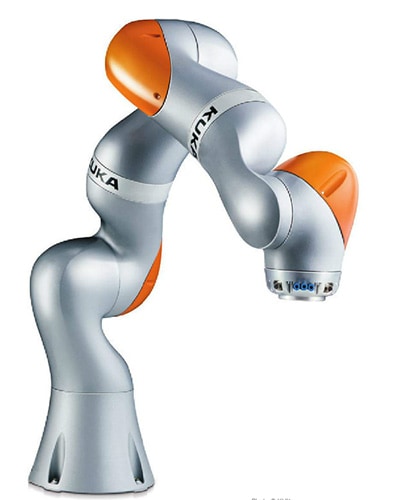
Title Image: KUKA’s LBR iiwa: LBR stands for “Leichtbauroboter” (German for
lightweight robot), iiwa for “intelligent industrial work assistant.”
By Steven Keeping for Mouser Electronics
Large, heavy industrial robots are commonplace in factories as a more efficient alternative to manual workers for
repetitive assembly-line tasks. The machines never slow down, never make mistakes, and never require time off. Yet
they are expensive and inflexible, demanding time-consuming reprogramming and retooling to switch to new tasks. This
makes industrial robots suitable for high-volume, high-speed processes where a product is produced for years without
change: Automotive chassis welding is a classic example of this.
Humans are not so good at highly-repetitive tasks because they tire and lose concentration. But humans are
dexterous, flexible, and good at solving problems. And human labor is relatively inexpensive. This makes humans well
suited for complex, high-mix assembly jobs, such as fitting an auto’s interior with multiple options that a
customer chooses.
Collaborative robots are light, inexpensive industrial robots designed to fill in gaps by working closely with
humans to bring automation to tasks that had previously been completed solely with manual labor. Robots offer
significant productivity gains while humans focus on servicing a rapidly changing product mix: Ultimately proving
that “collaboration” works. A study conducted by Massachusetts Institute of Technology (MIT) researchers
at a BMW factory showed that human idle time was reduced by 85 percent when they were assisted by collaborative
robots.
The applications for collaborative robots are numerous and varied. For example, a collaborative
robot could pick up a heavy dashboard from a storage area located near the auto line and move the dashboard into its
proper place for production, at the same time a human can be working to fit or blank off dashboard switches, make
the “awkward-to-reach” electrical connections, and precisely align the instrument console before fixing
it into place. Collaborative robots are also finding work in places like smartphone assembly lines where picking,
gluing, and pressing operations are completed by the machine while human workers fit circuit boards, screens, and
batteries all before fixing the components together with tiny screws. According to the automation firm ABB, 90
percent of today’s collaborative robots work in consumer electronics factories.
Collaborative robots are smaller, lighter, and cheaper than their industrial cousins, measuring tens of centimeters
rather than meters, weighing in at 10kg rather than a hundred, and costing tens of thousands of dollars rather than
hundreds of thousands. Collaborative robots borrow some technology from their larger cousins, such as motors and
joints, but this technology is refined, streamlined, and shrunk. Programming is much simpler than that required for
an industrial robot and is sometimes as simple as manually guiding a robot’s arm through the procedure: This
is so simple it can be performed by a coworker rather than a robot specialist technician. Maintenance is simple so
smaller companies with no previous robotics expertise can manage it. And because collaborative robots share the same
workspace with humans, they contain sensors and computing power to ensure coworkers aren’t bashed by
artificial arms, and if human and robot contact does happen, the forces involved are limited to prevent harm.
The collaborative robot sector holds much promise. Today, the machines bring automation to assembly tasks that were
previously completed by humans, freeing up those workers to concentrate on more intellectually-rewarding jobs.
Tomorrow, collaborative robots could ensure that production lines keep running in places where inexpensive human
labor is in short supply. This promise, according to UK analyst Technavio, will see the market for collaborative
robots expand tenfold, jumping to over $1 billion in as little as the next two years.
 Steven Keeping is a contributing writer
for Mouser Electronics and gained a BEng (Hons.) degree at Brighton University, U.K., before working in the
electronics divisions of Eurotherm and BOC for seven years. He then joined Electronic Production magazine and
subsequently spent 13 years in senior editorial and publishing roles on electronics manufacturing, test, and design
titles including What's New in Electronics and Australian Electronics Engineering for Trinity Mirror, CMP and RBI in
the U.K. and Australia. In 2006, Steven became a freelance journalist specializing in electronics. He is based in
Sydney.
Steven Keeping is a contributing writer
for Mouser Electronics and gained a BEng (Hons.) degree at Brighton University, U.K., before working in the
electronics divisions of Eurotherm and BOC for seven years. He then joined Electronic Production magazine and
subsequently spent 13 years in senior editorial and publishing roles on electronics manufacturing, test, and design
titles including What's New in Electronics and Australian Electronics Engineering for Trinity Mirror, CMP and RBI in
the U.K. and Australia. In 2006, Steven became a freelance journalist specializing in electronics. He is based in
Sydney.
 India
India